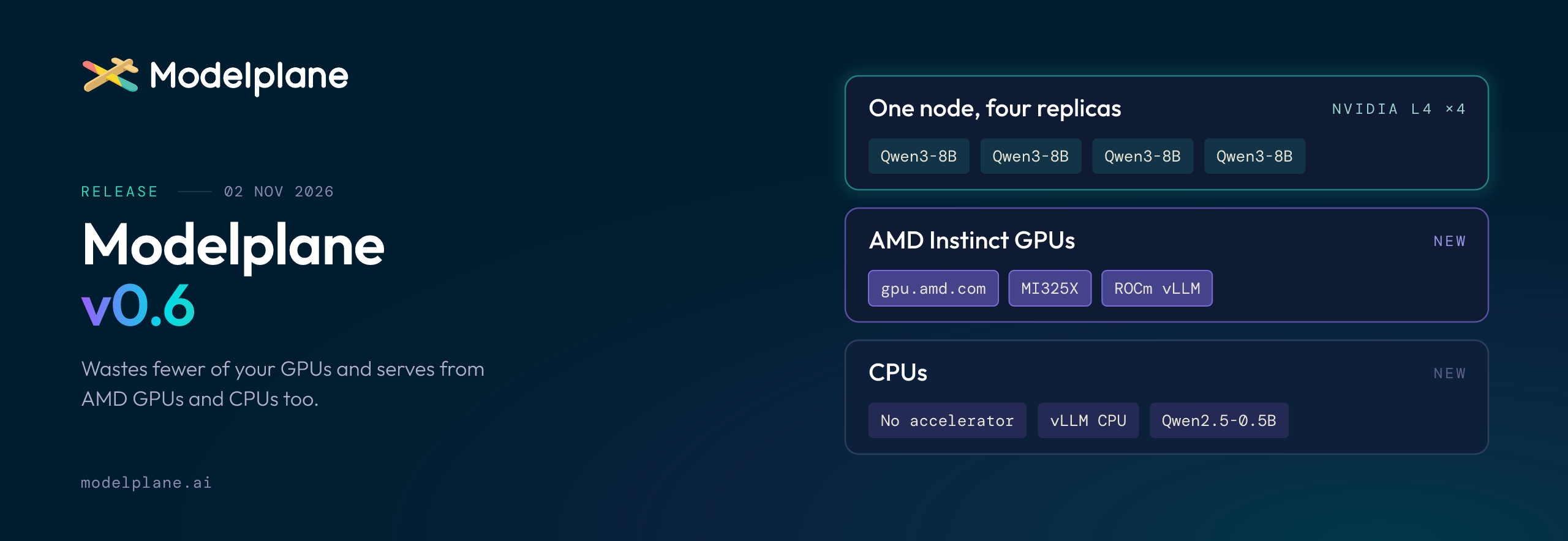

Modelplane v0.6 is out. Most of what's new helps you get more from the hardware you already have. Small models can now share a GPU node rather than each taking a whole one, and a fleet can serve from AMD Instinct GPUs and CPUs as well as NVIDIA GPUs. GKE and EKS node pools can also use capacity you've reserved. Separately, disaggregated prefill/decode serving now works with SGLang.
Small models share a node
Modelplane's fleet scheduler picks a cluster and a node pool for each model replica. It used to measure a pool's room in whole nodes, so every pod that claimed a GPU took a node to itself, however many of the node's GPUs it used. Qwen3-8B fits on one NVIDIA L4. A pool of two nodes with four L4s each has room for eight replicas of it, but the scheduler would place only two.
The scheduler now counts free GPUs instead, using an agent Modelplane installs
on every cluster. The InferenceCluster publishes the agent's counts in its
status. This pool has one node with one L4 free, and room to grow by two more
nodes:
status:
  schedulablePools:
  - name: gpu-l4x4-a
    nodes: 3          # The most nodes the pool can have.
    observedNodes: 1  # The nodes the pool has now, ready or not.
    nodesByFreeDevices:
    - freeDevices:
        gpu.nvidia.com: 1
      nodes: 1
    devices:
    - name: gpu
      claim: DRA
      driver: gpu.nvidia.com
      deviceClassName: gpu.nvidia.com
      count: 4
With these counts, four one-GPU replicas can share a four-GPU node, and a replica with two four-GPU engines fits on one eight-GPU node. The fleet scheduler still only picks the pool. Each cluster's own scheduler decides which node a pod runs on.
There's nothing to configure.
AMD GPUs and CPUs
A fleet can now serve from AMD Instinct GPUs and from CPUs as well as NVIDIA
GPUs. Describe a pool's devices in its InferenceClass and Modelplane installs
the software to drive them wherever they're needed. Here's the class from the
AMD recipe, which describes a pool of MI325X nodes:
apiVersion: modelplane.ai/v1alpha1
kind: InferenceClass
metadata:
  name: amd-mi325x-8x
spec:
  description: "BYO 8x AMD Instinct MI325X 256GB"
  devices:
  - name: gpu
    claim: DRA
    driver: gpu.amd.com
    deviceClassName: gpu.amd.com
    count: 8
    attributes:
      productName: { string: AMD_Instinct_MI325_OAM }
    capacity:
      memory: { value: "262128Mi" }
A ModelDeployment asks for devices the way a Kubernetes
DRA
claim does, with CEL expressions over the attributes and capacity a class
publishes. Nothing in that is specific to NVIDIA, so one fleet can serve from
both vendors. This deployment from the same recipe selects one AMD GPU with at
least 200Gi of memory:
apiVersion: modelplane.ai/v1alpha1
kind: ModelDeployment
metadata:
  name: qwen-demo
  namespace: ml-team
spec:
  replicas: 1
  template:
    spec:
      engines:
      - name: qwen
        members:
        - role: Standalone
          nodeSelector:
            devices:
            - name: gpu
              count: 1
              selectors:
              - cel: |
                  device.capacity["gpu.amd.com"].memory.compareTo(quantity("200Gi")) >= 0
          template:
            spec:
              containers:
              - name: engine
                image: rocm/vllm:rocm7.14.1_cdna_ubuntu24.04_py3.14_pytorch_2.11_vllm_0.23.0
                command: ["vllm", "serve", "Qwen/Qwen2.5-0.5B-Instruct"]
                args:
                - --served-model-name=$(MODELPLANE_SERVED_MODEL_NAME)
AMD GPUs report metrics under the same names as NVIDIA's.
A CPU pool is the cheapest way to try Modelplane end to end, since there's no
GPU to find. Leave the accelerator out of an InferenceClass and it describes
a CPU pool. The CPU recipe
serves Qwen2.5-0.5B this way on Civo, using vLLM's CPU image.
Prefill/decode with SGLang
Disaggregated serving splits a model across a prefill engine, which reads the prompt to build the KV cache, and a decode engine, which generates tokens from that cache. A router in front of them sends each request through both. On Modelplane that's llm-d's endpoint picker, plus a sidecar in each decode pod.
The router's configuration has to match the engines. Modelplane used to configure it for you, but only for vLLM, which left SGLang with a router it couldn't use.
In v0.6 you write a PrefillDecode deployment's router the same way you write
its engines, choosing the endpoint picker's image, flags, and configuration and
adding the sidecar to the decode pod. Modelplane runs the picker and wires it
into the cluster's gateway. Serving a new engine or KV transfer method no
longer waits on a Modelplane release, only on a router that supports it.
Unified deployments don't need any of this. They keep Modelplane's default
picker unless they set their own.
Here's an SGLang deployment, trimmed from the routing docs:
apiVersion: modelplane.ai/v1alpha1
kind: ModelDeployment
metadata:
  name: laguna-pd
  namespace: ml-team
spec:
  replicas: 1
  template:
    spec:
      modelCacheRef:
        name: laguna
      serving:
        mode: PrefillDecode
        router: EndpointPicker
        endpointPicker:
          template:
            spec:
              containers:
              - name: epp
                image: ghcr.io/llm-d/llm-d-router-endpoint-picker:v0.9.0
                # Omitted for brevity.
          config:
            apiVersion: llm-d.ai/v1alpha1
            kind: EndpointPickerConfig
            plugins:
            # SGLang's decode engine can't serve a request alone, so every
            # request goes through prefill.
            - type: always-disagg-pd-decider
            # Omitted for brevity.
      engines:
      - name: prefill
        phase: Prefill
        # Omitted for brevity.
      - name: decode
        phase: Decode
        members:
        - role: Standalone
          # nodeSelector omitted for brevity.
          template:
            metadata:
              labels:
                llm-d.ai/engine-type: sglang
            spec:
              containers:
              - name: sidecar
                image: ghcr.io/llm-d/llm-d-router-disagg-sidecar:v0.9.0
                args:
                - --secure-proxy=false
                - --kv-connector=sglang
                - --vllm-port=8001  # The decode engine's port, whatever the engine.
                ports:
                - containerPort: 8000
                # readinessProbe omitted for brevity.
              - name: engine
                image: lmsysorg/sglang:v0.5.12.post1-cu129
                command: ["python3", "-m", "sglang.launch_server"]
                args:
                - --model-path=poolside/Laguna-S-2.1-FP8
                - --served-model-name=$(MODELPLANE_SERVED_MODEL_NAME)
                - --tp-size=8
                - --port=8001
                - --disaggregation-mode=decode
                - --disaggregation-transfer-backend=nixl
                # Omitted for brevity.
                ports:
                - name: http
                  containerPort: 8001
Reserved capacity
The largest GPU machines can be hard to get without a reservation. GKE node
pools can now use a Compute Engine reservation you've already bought. EKS pools,
which could already use a Capacity Block, can now use an On-Demand Capacity
Reservation too. Register the reservation as a CapacityReservation and
reference it from the pool:
apiVersion: modelplane.ai/v1alpha1
kind: CapacityReservation
metadata:
  name: l4-reservation
spec:
  provider: GKE
  gke:
    zone: us-central1-a
    name: l4-reservation
---
apiVersion: modelplane.ai/v1alpha1
kind: InferenceCluster
metadata:
  name: gke-reserved
spec:
  cluster:
    source: GKE
    gke:
      region: us-central1
  nodePools:
  - name: l4-pool
    className: gke-l4-1x-g2
    nodeCount: 2
    maxNodeCount: 2
    zones: [us-central1-a]
    reservationRef:
      name: l4-reservation
A pool that references a reservation gets nodes only from it, never from on-demand capacity.
Degraded replicas keep serving
An engine can run several copies within a replica. A replica used to take
traffic only while every copy of every engine was ready, so one crashed copy
withdrew the whole replica and took a one-replica deployment offline until the
copy came back. Now a replica keeps serving as long as one copy of each engine
is ready, and the endpoint picker sends requests only to the copies that are
up.
Ready still means full capacity. In kubectl get, a new SERVING column shows
a degraded deployment as serving even though it isn't ready.
GPU metrics on Nebius
Modelplane now installs NVIDIA's DCGM exporter on Nebius clusters. Their GPU
metrics show up under Modelplane's modelplane_gpu_* names, where before
there were none.
Try it
The full release notes are on GitHub. The getting-started guide covers standing up a fleet. If you're a platform engineer new to inference, Annie Talvasto's field guide to inference engineering covers the concepts, production operations, and tooling you'll meet. Modelplane is Apache 2.0 and moving fast at github.com/modelplaneai/modelplane. Questions are welcome in Slack.