We open sourced Modelplane on June 23. Less than five months later, we've shipped six releases, welcomed contributions from people outside the original team, started running our own engineers' coding agents and security workflows on the project, and brought the people building the inference stack together for Inference Day. This week, from the KubeCon keynote stage, Bassam shared another milestone: Upbound has submitted Modelplane to the CNCF for consideration as a Sandbox project.
The submission matters, but what makes this moment worth celebrating is the work that led here. Models, serving engines, accelerators and infrastructure providers are evolving independently. Managing them together as one heterogeneous fleet is becoming a job of its own. We wanted to help build the control plane for that job, in the open, with the people who will actually use and extend it.
The industry is moving horizontally for practical reasons, not because GPUs have become cheap or plentiful. Capacity is constrained, models have very different economics and capabilities, and the best choice for one workload may be completely wrong for another. Enterprises need to bring their existing cloud commitments, neocloud capacity and private infrastructure together without being locked into one model, engine or accelerator. A fleet-wide control plane can help make those choices usable. That was the idea behind Modelplane's first release, and it's shaped the work we've done since.
The first release gave teams a way to provision or bring their own inference clusters, schedule model replicas onto compatible GPUs, cache model weights and serve requests through one OpenAI-compatible endpoint. It was an ambitious starting point, but it gave us something real to build on. In July, v0.2 added Azure AKS and Nebius support alongside weighted routing and controls for reserving or draining capacity. In August, v0.3 brought Vultr VKE, end-to-end support for the Anthropic Messages API, including coding-agent workflows, and local testing across two clusters without needing cloud infrastructure or a GPU.
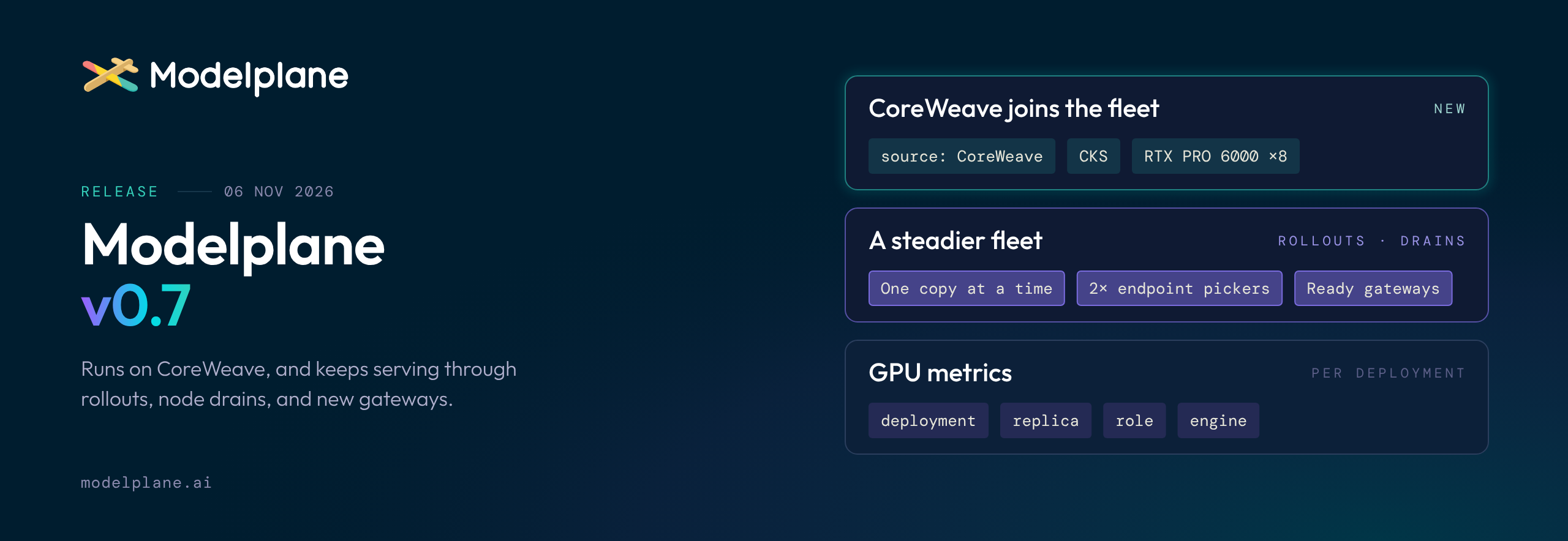
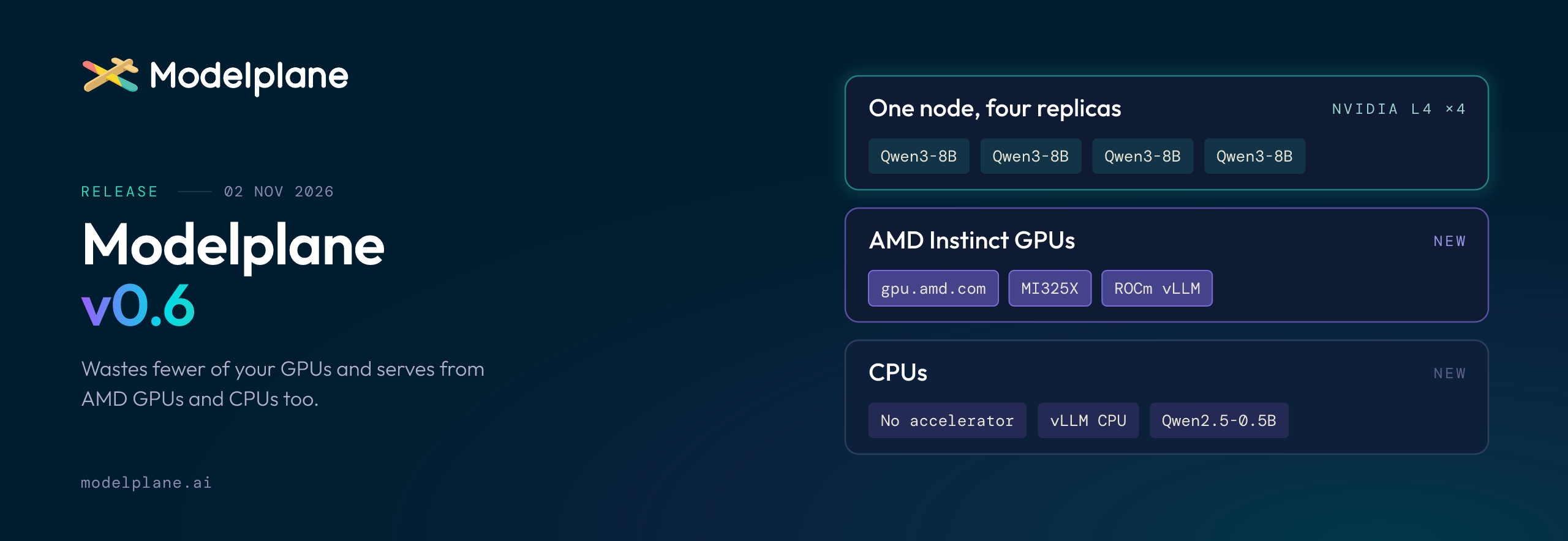
September's v0.4 grew out of collaboration with the NVIDIA team, adding a Dynamo serving stack with Grove, the KAI Scheduler and ModelExpress, as well as NVIDIA AI Cluster Runtime integration. October's v0.5 strengthened the day-to-day operating story with an AI gateway, regional gateway placement, fleet-wide telemetry, scale-to-zero and support for Civo. Then v0.6, released on October 30, tackled some particularly practical limits: scheduling on free GPUs rather than whole nodes so smaller models can share hardware, support for AMD Instinct and CPU serving, and more flexible SGLang prefill/decode configurations. None of these releases is the finish line; together, they show how quickly the project is beginning to accommodate a broader inference ecosystem.
The work hasn't been confined to the original maintainers. The release notes have welcomed first-time contributors, including @adamwg and @ytsarev earlier in the project and @RedbackThomson and @jbw976 in v0.6. Their changes range from making development and documentation more approachable to improving the underlying platform. Those contributions matter because an open control plane only becomes useful to a wider ecosystem when people outside the original design conversation can shape it.
On November 5, we hosted Inference Day to bring the people building the inference stack into one conversation. Kelsey Hightower opened with a fireside chat about what platform teams should build now—and what lessons from cloud native are worth carrying forward. The serving panel brought maintainers from NVIDIA Dynamo, KServe, Envoy AI Gateway and Modelplane together around the path from a request to a running engine. Another connected Kubernetes, Metal3, Crossplane and Modelplane contributors around the infrastructure underneath models, from clouds to bare metal. A third focused on the practical work of operating inference: observability, cost and reliability. Viktor Farcic closed with Inference 101.
That lineup made the horizontal ecosystem story real. No one project can or should own every layer, and platform engineers need to understand how the pieces interact. We also published An Open Field Guide to Inference Engineering, drawing on the work of the wider community and our own experiments. It walks through the familiar skills—scheduling, capacity, load balancing and incident response—and what changes when the workload is inference.
Champagne: what happened when we became our own users
One of the most important things we did was admit an uncomfortable truth: we were building technology for self-hosted inference, but we weren't depending on it ourselves. Project Champagne changed that. We put internal chat, coding agents and a build-security agent onto models served through Modelplane and asked our engineers to use them for real work. We also made a rule: don't hide an issue in a private fork. Work around it temporarily if necessary, but file it, fix it upstream and write down what happened.
That decision exposed problems before we even got to model quality. An approved GPU quota didn't mean the instance was available; our first-choice H100 shape never launched, and another GPU shape was unavailable in several zones. A response could return HTTP 200 after being silently truncated. A long-running agent could outlive the credentials or timeouts set up for an ordinary request. We learned that the environment around a model mattered at least as much as the model itself.
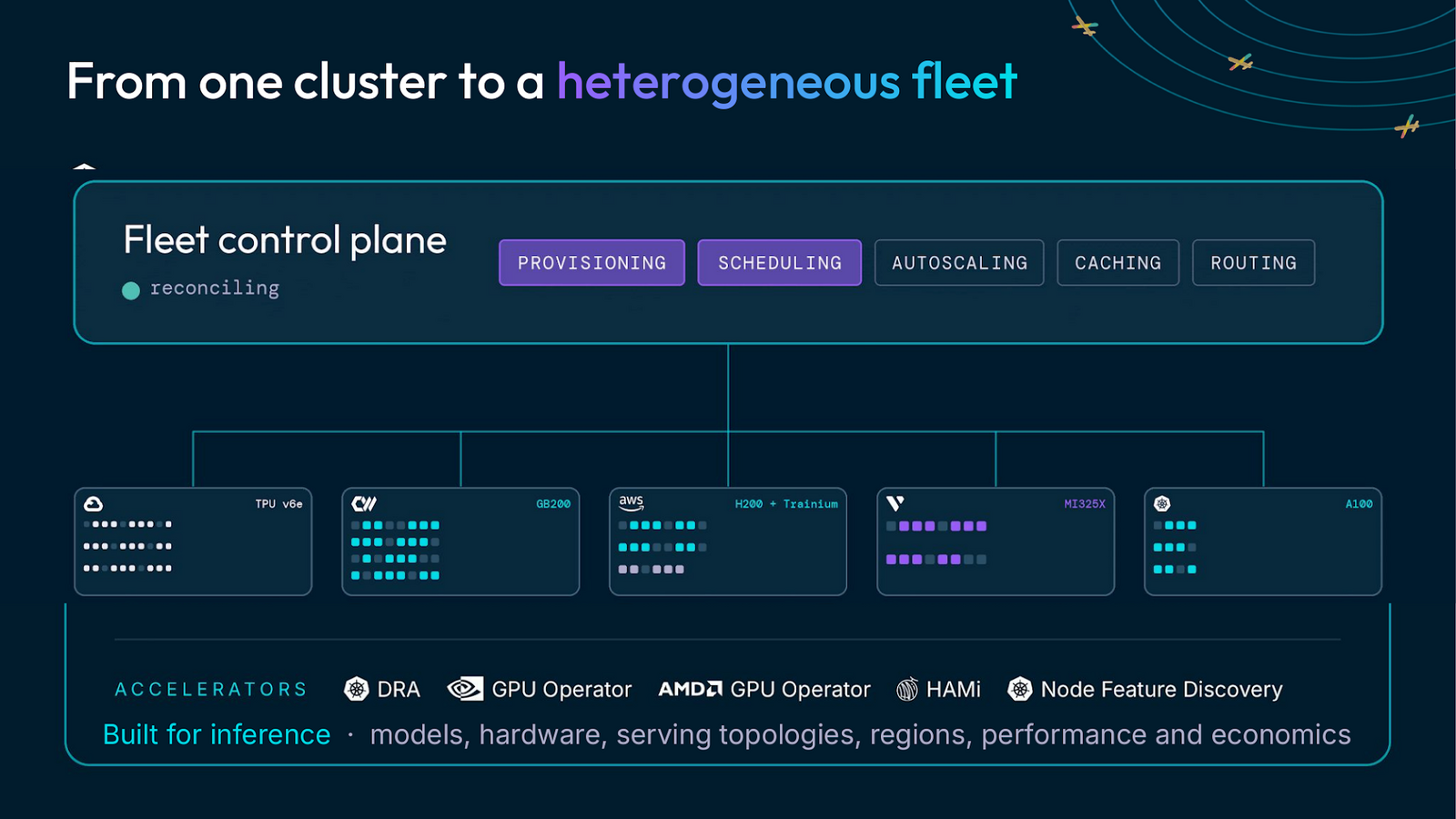
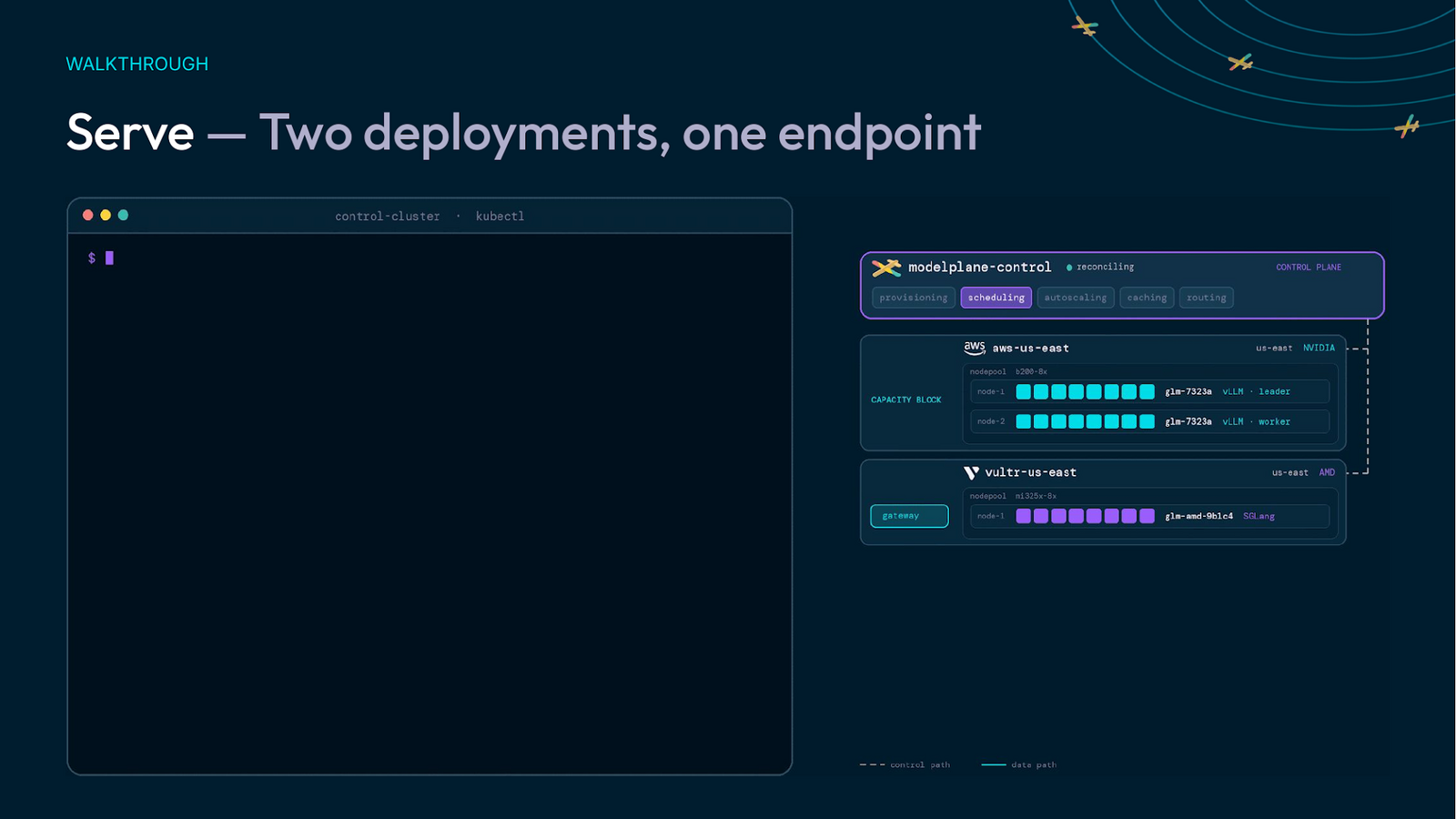
That experience has reinforced why we've focused on operating a heterogeneous fleet rather than one ideal cluster. At KubeCon + CloudNativeCon North America, Bassam demonstrated the same idea from another angle: the same model running on NVIDIA GPUs in AWS and AMD GPUs on Vultr, with different serving engines behind one endpoint. The infrastructure and serving technology could change while the application-facing interface stayed consistent. It's a demonstration of the fleet-wide operating model we're building—and the kind of flexibility that matters when available capacity and workload needs keep changing.
The most revealing failure looked exactly like a bad model. For roughly two weeks, a coding model mangled tool names, omitted fields and produced nonsense that made our engineers question whether open models were ready. Then we asked it to copy back 50 names. With vLLM it succeeded 30% of the time; with SGLang, using the same weights on the same GPUs, it succeeded 100%. We hadn't changed the intelligence. We'd changed the software serving it.
The build-security agent taught us a different kind of caution. Open models could find known CVEs, but a convincing-looking fix plan could still recommend the wrong patched version. In other cases the evaluation harness, a timeout or the grader—not the model—explained a disappointing score. If we were going to use self-hosted inference for real work, we needed to test the whole system rather than infer quality from a single answer.
And getting a useful pilot wasn't the same as serving a team. About ten engineers were trying a self-hosted coding model. We tested seven serving recipes to understand what it would take to support fifteen, changing one variable at a time. Two GPU nodes couldn't meet the test; four nodes using SGLang could, at roughly what we were already paying per engineer. One surprise: supposedly light users could generate more concurrent requests than heavy users because their agents spawned subagents.
These lessons have guided very practical upstream fixes: gateway TLS and API keys, configurable request and idle timeouts, OpenTelemetry collection, scale-to-zero and more useful serving metrics. Not every issue is solved, and we've been explicit about the ones still open. We published the complete six-part Champagne series because our own code isn't the only thing that should improve. Other engineers should be able to inspect the experiments, question the results and avoid repeating our mistakes.
That's why the CNCF submission feels like a continuation of the work, not a separate announcement. We've learned from contributors, integration partners, the people who came to Inference Day and engineers willing to use an unfinished system in their daily work. The values behind Champagne—use what you build, share the failures and bring the fixes back—are the same ones we want to carry into a broader community. Modelplane is still Apache 2.0 licensed and still early. We've submitted it for consideration as a CNCF Sandbox project; acceptance has not yet been decided. A neutral home would give people building models, engines, accelerators and infrastructure a stronger place to shape a common fleet-wide control plane together.
Join us for what's next
We're proud of the six releases, new infrastructure and serving integrations, and contributions from outside the original team. We're equally proud of the untidy parts: GPU requests that failed, serving configurations that lost, broken tool calls and experiments that changed our minds. They're the parts worth sharing because they make a young project more useful. If you're building any part of the inference stack—or suddenly finding yourself responsible for operating it—we'd love to compare notes, learn from what you've seen and build the next part together.
The six-part Champagne series tells the longer engineering story, including the things that didn't fit into a keynote demo:
- Part 1 — What It Takes to Own Your Intelligence: why we moved our own workloads.
- Part 2 — Finding the Corks: capacity, gateways, authentication and the failures that looked healthy.
- Part 3 — The Build Security Agent: evaluating self-hosted models against a real CVE workflow and learning when to distrust the grader.
- Part 4 — Candling the Bottles: building observability that exposes the failures status fields can hide.
- Part 5 — Growing a Self-Hosted Coding Model From Pilot to Team: testing concurrency and the user experience before expanding adoption.
- Part 6 — The Model Was Rarely the Problem: the operational lessons and improvements flowing back into Modelplane.
If you've hit a strange failure in your own inference setup, bring it to the community. The project is still young, and there's a lot more we can learn in public.
Come find us on GitHub, in the community Slack, and in the documentation.